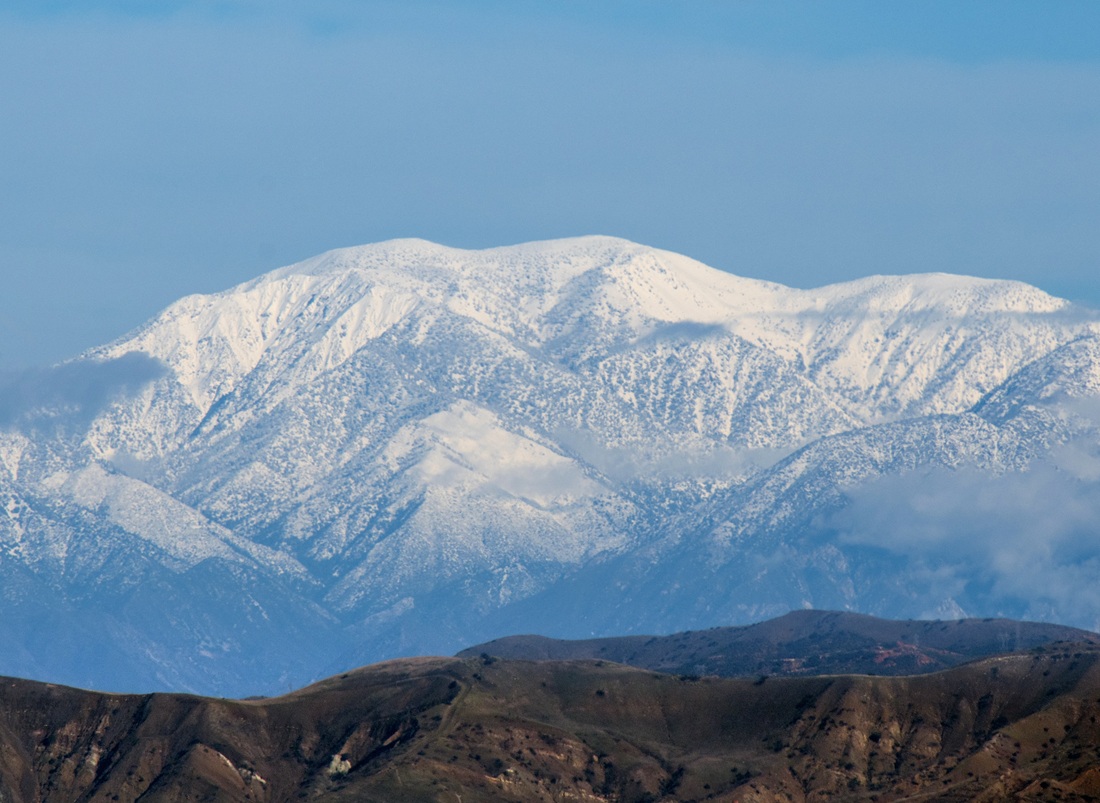
The Santa Ana Mountains in Orange County are one of Southern California’s most iconic natural landmarks, providing a dramatic and beautiful backdrop to communities throughout the region.
Stretching from the Whittier Fault in the north to the Santa Margarita River in the south, the range includes several prominent peaks. Among the highest are Modjeska Peak (5,496 feet) and Santiago Peak (5,689 feet), which together form the well-known Saddleback silhouette visible across much of Orange County.
They’re a large part of our county’s culture and history. They stand more majestic than the Santa Monica Mountains, the Verdugo Mountains, Puente Hills, Coyote Hills – all of which have active faults under them.
How did our Santa Ana ridgeline come to be? Did an earthquake fault cause them to rise long ago?
To answer that, let’s step back and take a look at the small but lovely San Joaquin Hills nearby.
A University of California, Irvine, researcher in the early 2000s set out to study the source of that coastal ridge, and presented evidence that it rose from the sea because of an undiscovered blind thrust fault capable of producing an earthquake up to magnitude 7.1.
Lisa Grant, an expert in paleoseismology, earthquake geology, neotectonics, environmental geology and public health, determined the San Joaquin Hills fault runs northwest to southeast following the coastline near the 405 Freeway at the Santa Ana River, to the El Toro Y and then along the 5 freeway to Dana Point – snaking its way under Newport Beach, Irvine, Aliso Viejo, Laguna Hills, Laguna Beach, and San Juan Capistrano.
Later her research turned to the larger Santa Ana mountains – believing those peaks, which the USGS says are growing at a rate of 3/10 of a millimeter per year – are the result of a blind thrust fault.
To date, the existence of that fault has not yet been proven.
“We haven’t had that earthquake to tell us exactly where it is,” she said in a UCI article on her research.
Another Puente Hills?
Don’t think the lack of proof means the fault isn’t there.
Seismologists have since discovered a hidden fault in Los Angeles more dreaded than the San Andreas.
A study by the University of Southern California says the Puente Hills Fault has the capacity to produce “the costliest disaster in U.S. history.” As many as 18,000 people would die, 735,000 would lose their homes, and up to 100,000 tons of debris would be generated. The total economic loss would be as high as $252 billion.
Puente Hills is a blind thrust quake, the same kind Grant said the undiscovered fault under the Santa Anas would be. She based those findings on the geology of the ridge. Blind thrust faults rupture with one side of the fault pushing up and over the bottom side.
It was this type of fault that set off the deadly Northridge quake of 1994.
Thrust earthquakes create an accumulated strain that bends the earth’s crust in spots, where the fault has locked up. Seismologists believe that these areas are most prone to future earthquakes.
Is Grant right? Is Orange County truly threatened by its own sleeping giant of a fault? Only time will tell.
Call Optimum Seismic at 833-978-7664 for more information